Learn Tarot With a Simple Beginner Practice Plan
June 26, 2026 | By Orion Drake
Learning tarot can feel bigger than it really needs to be. A full deck has 78 cards, several suits, court cards, symbols, spreads, reversals, and a long history of different reading styles. But you do not have to master everything before your first useful reading. The best way to learn tarot is to build a small, repeatable practice: pull one card, notice what you see, compare it with a clear meaning, and write down what felt relevant. If you want a low-pressure place to practice without setting up a physical deck, an online daily card pull can help you focus on one card at a time.

What Learning Tarot Really Means
To learn tarot is not just to memorize card definitions. Memorization helps, but tarot becomes clearer when you understand the deck as a symbolic language. Each card gives you a scene, a mood, a question, and a set of traditional meanings. Your job is to connect those layers to the question in front of you.
For beginners, that means three skills matter more than speed. First, learn the basic structure of the deck: Major Arcana, Minor Arcana, suits, numbers, and court cards. Second, practice reading card images before you rush to a guidebook. Third, keep your interpretations reflective instead of absolute. Tarot can support journaling, self-observation, and creative thinking, but it should not replace medical, legal, financial, or other professional advice.
This approach also removes the pressure to be "psychic." A useful tarot reading can come from attention, pattern recognition, intuition, and honest reflection. You are learning to ask better questions and notice more detail, not proving that every card has one fixed answer.
Start With a Small Deck Routine, Not a Huge Course
Many beginners try to learn all tarot cards at once, then feel stuck after a few days. A smaller routine works better. Choose one consistent practice format for your first two to four weeks. The easiest option is a one-card pull, because it lets you spend real time with one image instead of juggling a full spread.
If the whole deck feels overwhelming, begin with Major Arcana only. These 22 cards carry broad themes such as beginnings, choice, change, patience, strength, and completion. Once you feel comfortable seeing those bigger patterns, add the Minor Arcana and learn how the suits bring daily life into the reading.
A simple routine can look like this:
- Ask one open-ended question.
- Pull one card.
- Describe the image before checking a meaning.
- Write one sentence about the traditional meaning.
- Write one sentence about how it might apply to your day.
You can do this with a physical deck, an app, or a quick single-card tarot practice when you want to keep the process light. The important part is consistency, not the format.
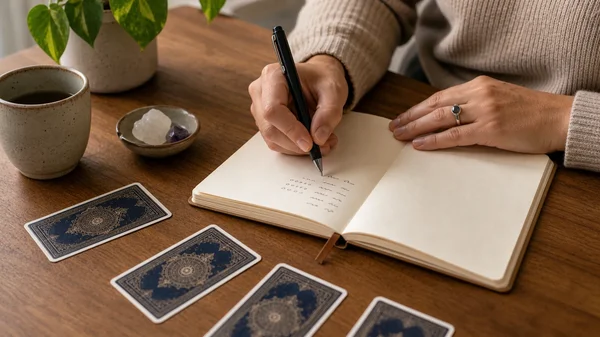
Learn Tarot Card Meanings in Layers
Tarot card meanings become easier when you stop treating every card as an isolated fact. Learn the deck in layers.
Major Arcana as Life Themes
The Major Arcana is often the easiest entry point because each card feels like a large archetype. The Fool can suggest a beginning, The Hermit can point toward solitude or inner study, and Strength can suggest patience, courage, and gentle control. You do not need to flatten each card into one keyword. Instead, give each card a small range of meanings and ask which part fits the question.
Minor Arcana by Suit and Number
The Minor Arcana becomes less intimidating when you learn suits and numbers together. Wands often relate to energy, action, desire, and creative movement. Cups often relate to emotion, connection, and inner life. Swords often relate to thoughts, conflict, communication, and decisions. Pentacles often relate to work, resources, body, time, and material reality.
Then add numbers. Aces can suggest beginnings or raw potential. Twos often involve balance, choice, or partnership. Tens can suggest completion, weight, or culmination. When you combine suit plus number, a card such as the Ten of Wands becomes easier to remember: action and effort carried to a heavy endpoint.
Court Cards as Roles and Attitudes
Court cards often frustrate new readers because they can represent people, parts of yourself, styles of action, or the mood of a situation. Keep them simple at first. Pages can be learners and messengers. Knights can be movement and pursuit. Queens can be inner mastery and receptive leadership. Kings can be outward authority and mature expression. Over time, your journal will show which court-card meanings feel most useful in your own readings.
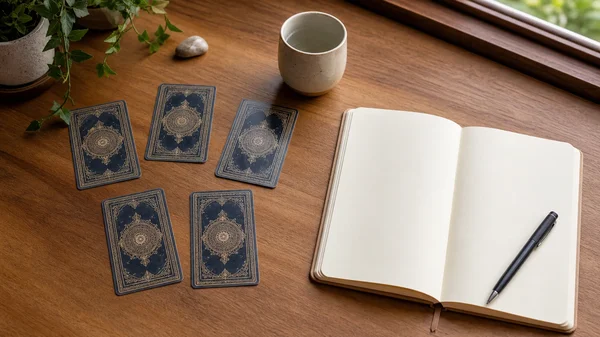
A 20-Minute Practice Loop for Learning Tarot Cards
If you want to learn tarot fast, do not try to rush the whole deck. Short, focused repetition is faster than scattered study. A 20-minute loop gives you enough structure without turning tarot into homework.
Use the first five minutes for intention. Ask one open question, such as "What should I pay attention to today?" or "What pattern am I ready to understand more clearly?" Avoid questions that demand certainty, especially about other people's private thoughts or major life decisions.
Use the next five minutes for observation. Look at the card before reading any meaning. Notice the figures, colors, direction of movement, weather, posture, objects, and emotional tone. Write what you see in plain language.
Use the next five minutes for study. Check one trusted meaning source. Do not open ten tabs or compare every possible interpretation. Too many sources can make a beginner less confident. One guidebook, one PDF, one course lesson, or one structured app is enough for a single session.
Use the final five minutes for reflection. Write three short notes: the card, the core meaning, and one grounded takeaway. The takeaway should sound like a reflection, not an order. For example, "I may need to slow down before answering" is healthier than "I must cancel everything because this card appeared."
Repeat this loop for 14 days. By the end, you will have a small personal record of card meanings, questions, and patterns. That record becomes more useful than a pile of disconnected notes.
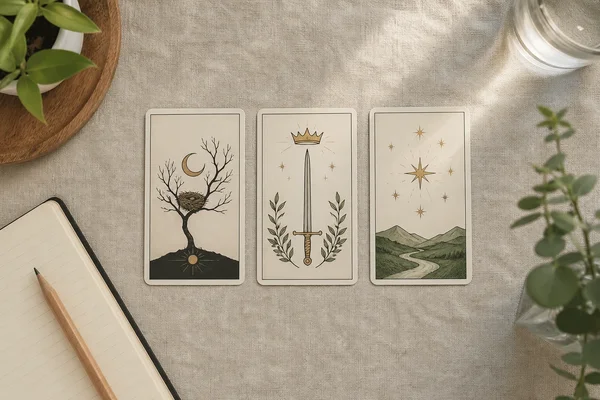
How to Read Tarot Cards Without Getting Stuck
Beginners often get stuck because they expect a card to deliver a full answer by itself. Tarot reading works better when you combine card meaning, question, position, and context.
For a one-card reading, keep the question narrow. "What energy should I bring to this conversation?" is easier to read than "What will happen in my life?" The card becomes a lens for reflection instead of a prediction machine.
For a two-card reading, give each card a role. Try "challenge and support," "what I see and what I may be missing," or "current pattern and helpful adjustment." This helps you learn card combinations without getting lost.
For a three-card reading, use a simple structure such as past, present, and next step. Beginners often jump into large spreads too early. Larger spreads are not automatically better. They create more information, but they also create more places to lose the thread.
When a card confuses you, ask three questions before looking up more meanings:
- What is happening in the image?
- What emotion does the card create?
- How does the card's suit, number, or Major Arcana theme relate to the question?
This gives your intuition something concrete to work with. It also prevents you from treating a guidebook as the only possible answer.
Free, App, PDF, Video, and Course Options
Searches for learn tarot often include PDFs, apps, YouTube lessons, free courses, and classic names such as Joan Bunning. Those resources can help, but the best choice depends on how you learn.
Use a PDF or book if you like quiet study and want one stable reference. This is useful for building a personal keyword list for each card. Use a tarot app if you want reminders, card archives, and quick meanings on your phone. Use video if you learn by watching someone handle cards, connect meanings, and talk through a reading. Use an online course if you want sequence, assignments, and a clear path.
The risk is resource-hopping. A beginner can spend more time collecting tarot learning material than actually reading cards. Pick one main resource for meanings, one practice method, and one journal. After a month, review what helped and what confused you. Then adjust.
You can also learn tarot cards for free if you are disciplined about practice. Free resources are enough for basic meanings, daily pulls, and simple spreads. Paid courses or books may add structure, but they are not required before you begin reading for yourself.
Do's and Don'ts While You Learn Tarot
Do ask open questions. "What can I understand about this choice?" is usually better than "Will this exact thing happen?"
Do keep a tarot journal. It does not need to be beautiful. A useful entry can be only four lines: date, question, card, reflection.
Do compare your first impression with a traditional meaning. This trains both observation and study.
Do read ethically. If you practice with another person, make it clear that you are learning. Respect privacy, boundaries, and consent.
Do not use tarot to make high-stakes decisions for someone else. Keep the reading reflective, especially around health, money, law, safety, and relationships.
Do not panic over difficult cards. Swords, Death, The Tower, and the Ten of Wands can feel intense, but they are not automatically disasters. Read them as prompts for awareness, pressure, change, or release.
Do not chase one perfect interpretation. The best way to learn tarot is to build a relationship with the deck through repeated, grounded practice.
And if you wonder what tarot card represents Leo Rising, treat that as an astrology-tarot correspondence question rather than a universal rule. Leo is often associated with Strength because of the lion imagery and themes of courage, but a rising sign does not have one fixed tarot card in every system.
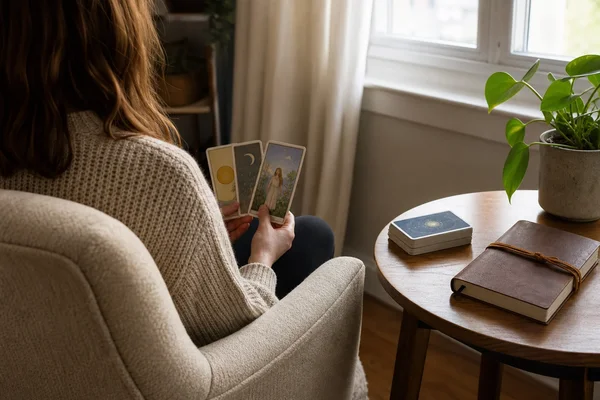
Build a Daily Tarot Learning Habit
The most sustainable way to learn tarot is to make the practice small enough that you can repeat it. One card, one question, one note, one honest reflection. That is enough for a beginner.
As your confidence grows, move from one-card readings to pairs, then to simple three-card spreads. Add the full deck when Major Arcana only feels too narrow. Study meanings in layers instead of trying to memorize the whole system in one sitting. Most importantly, keep your readings practical and gentle. Tarot works best as a mirror for reflection, not as a command.
When you want a quick reset between deeper study sessions, a simple reflective tarot pull can help you return to the habit without making the process complicated. Over time, those small readings teach you how cards speak together, how your questions shape interpretation, and which meanings actually hold up in daily life.
FAQ
Can I teach myself tarot cards?
Yes. Many people teach themselves tarot with a deck, a guidebook or online meaning source, and a journal. The key is steady practice. Pull one card often, write your interpretation before checking the meaning, then compare your notes with what happened or what you learned.
What is the best way to learn tarot?
The best way is a simple loop: learn the deck structure, pull cards regularly, record your impressions, check reliable meanings, and review your notes. Avoid trying to memorize all 78 cards before doing any readings. Practice gives the meanings context.
How long does it take to learn tarot card reading?
You can learn basic one-card readings within a few weeks of consistent practice. Feeling comfortable with the full deck, card combinations, and more complex spreads usually takes longer. Tarot is a continuing practice, so progress matters more than finishing.
Should beginners learn Major Arcana first?
Major Arcana is a good starting point because it gives you 22 strong themes instead of all 78 cards at once. However, you do not have to stay there forever. Once the major themes feel familiar, add the suits and numbers of the Minor Arcana.
Do I need a tarot course or can I learn tarot free?
You can learn tarot free with consistent practice and reliable meaning resources. A course can help if you want structure, assignments, and feedback, but it is not required for basic personal readings.
What should I avoid when learning tarot?
Avoid fear-based interpretations, yes-or-no obsession, reading about people without consent, and using tarot as professional advice. Also avoid switching resources every day. One clear study source and one steady practice routine will teach you more.
Is it better to use an app, PDF, book, or video?
Use the format you will actually return to. Apps are convenient, PDFs and books are stable references, and videos can show how a reader thinks through a spread. The format matters less than regular practice and honest reflection.