Tarot Card Numbers: A Clear Guide to the 78 Cards
August 3, 2026 | By Orion Drake
Tarot card numbers can feel confusing at first because a deck has two numbering systems working at the same time. The Major Arcana usually runs from 0 to 21, while the Minor Arcana repeats Ace through 10 across four suits, then adds court cards. Once you see that structure, the full 78-card deck becomes much easier to scan, study, and use in a daily pull. If you want to test the ideas as you read, a random tarot card draw can give you one card to place inside the number system below.
What Tarot Card Numbers Mean
In tarot, numbers do two practical jobs. First, they help you find a card in the deck. Second, they add a layer of symbolic meaning. That does not mean every number gives a fixed prediction. A number is better understood as a prompt: it points toward a stage, pattern, or kind of movement that can help you reflect on the card.
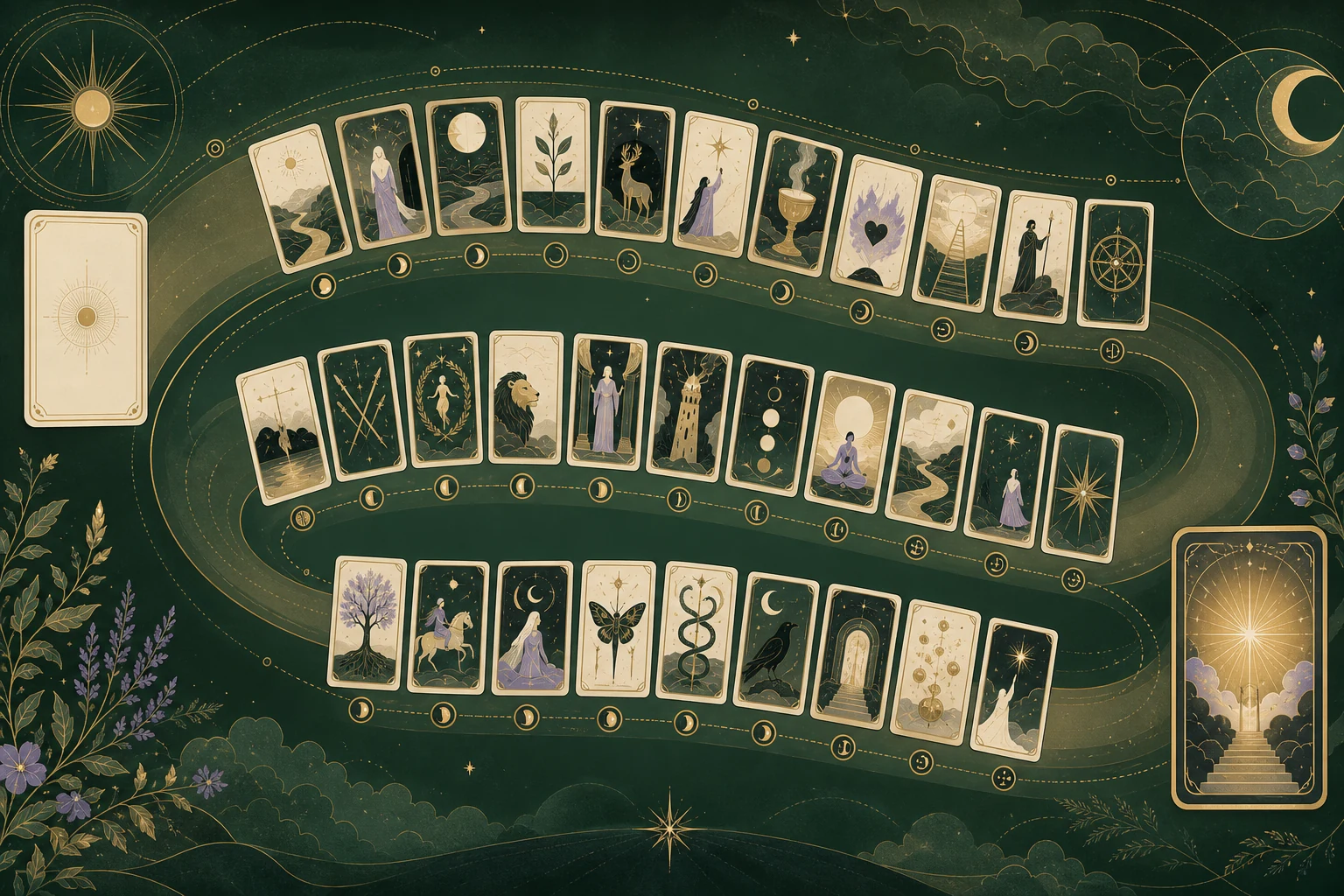
The Major Arcana is the easiest place to see this. These twenty-two cards are often read as a symbolic journey from The Fool to The World. The Fool is numbered 0 because it represents openness, beginning, and the space before a defined path. The World is 21 because it suggests integration, completion, and a larger cycle coming together.
The Minor Arcana uses numbers differently. Each suit has Ace through 10, so a Two of Cups and a Two of Swords share a basic number theme, but the suit changes the area of life being emphasized. Cups often point toward feelings and relationships, Swords toward thoughts and communication, Wands toward energy and action, and Pentacles toward material life, work, body, or resources.
The safest way to use tarot card numbers is to combine three pieces: the number, the suit or arcana group, and the actual image or traditional meaning of the card. Numbers are not a replacement for the card. They are a shortcut for noticing patterns.
Tarot Card Numbers in Order: Major Arcana 0-21
The Major Arcana contains 22 cards. Many decks print them with Roman numerals, so you may see The Magician as I, The High Priestess as II, and so on. The Fool is commonly 0, though some historical decks leave it unnumbered or place it differently. Strength and Justice can also swap numbers in some traditions: many modern Rider-Waite-Smith-style decks use Strength as VIII and Justice as XI, while some older or Marseille-style systems use Justice as VIII and Strength as XI.
| Number | Roman numeral | Major Arcana card | Simple number theme |
|---|---|---|---|
| 0 | 0 | The Fool | beginning, openness, possibility |
| 1 | I | The Magician | will, skill, focused action |
| 2 | II | The High Priestess | intuition, hidden knowledge, pause |
| 3 | III | The Empress | growth, creativity, nurture |
| 4 | IV | The Emperor | structure, order, authority |
| 5 | V | The Hierophant | learning, tradition, shared values |
| 6 | VI | The Lovers | choice, alignment, relationship |
| 7 | VII | The Chariot | direction, discipline, movement |
| 8 | VIII | Strength | courage, patience, inner steadiness |
| 9 | IX | The Hermit | reflection, solitude, wisdom |
| 10 | X | Wheel of Fortune | cycles, change, turning points |
| 11 | XI | Justice | fairness, truth, consequences |
| 12 | XII | The Hanged Man | pause, surrender, new perspective |
| 13 | XIII | Death | ending, release, transformation |
| 14 | XIV | Temperance | balance, blending, moderation |
| 15 | XV | The Devil | attachment, temptation, limitation |
| 16 | XVI | The Tower | disruption, revelation, rebuilding |
| 17 | XVII | The Star | hope, renewal, calm trust |
| 18 | XVIII | The Moon | uncertainty, dreams, intuition |
| 19 | XIX | The Sun | clarity, warmth, confidence |
| 20 | XX | Judgement | awakening, review, calling |
| 21 | XXI | The World | completion, integration, wholeness |
This table answers a common search question: what tarot is number 7? In the Major Arcana, number 7 is The Chariot. If you pull it, the number itself emphasizes direction and momentum. The card still needs context, but the number can remind you to ask: what am I trying to steer, and what would focused movement look like?
Tarot Card Numbers in the Minor Arcana
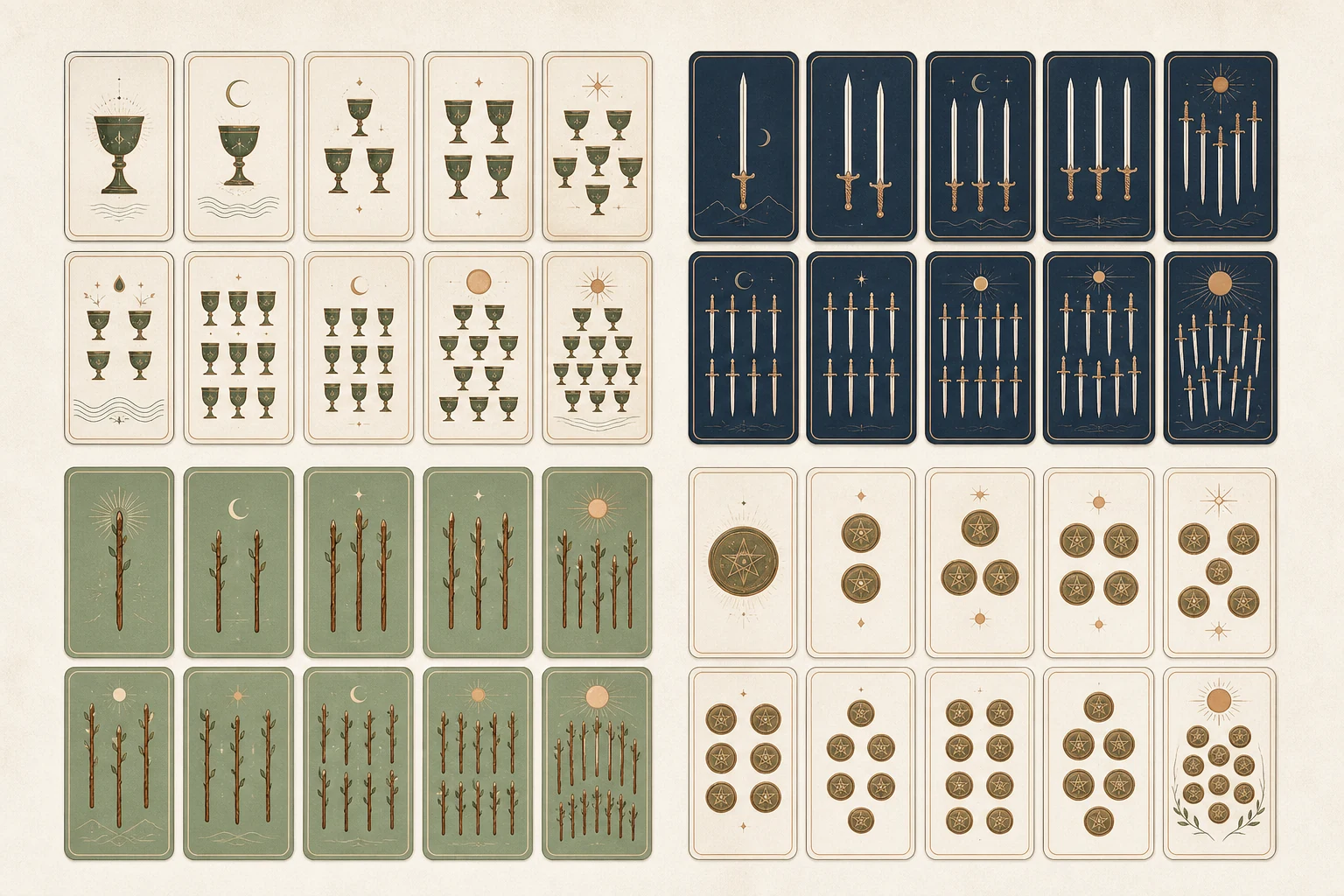
The Minor Arcana has 56 cards: four suits with 14 cards each. In each suit, the numbered cards run Ace, Two, Three, Four, Five, Six, Seven, Eight, Nine, and Ten. After the Ten come the court cards: Page, Knight, Queen, and King. The court cards are part of the Minor Arcana, but they are usually not numbered in the same way as Ace through 10.
Here is a simple way to remember the Minor Arcana number cycle:
| Number | Broad meaning across the suits |
|---|---|
| Ace | seed, fresh energy, potential |
| Two | choice, balance, pairing, contrast |
| Three | growth, expression, early results |
| Four | structure, stability, containment |
| Five | conflict, change, pressure, challenge |
| Six | repair, harmony, return, generosity |
| Seven | reflection, testing, strategy, evaluation |
| Eight | movement, effort, practice, momentum |
| Nine | ripening, independence, near completion |
| Ten | completion, fullness, burden, transition |
This is where tarot cards and numbers become especially useful. If several Fives appear in a spread, you may notice a theme of pressure or adjustment. If several Sixes appear, the reading may feel more concerned with repair, balance, or generosity. A simple tarot card pull can also be read this way: even one card has a number, and that number can become a journaling prompt.
The suit keeps the meaning grounded. The Seven of Cups is not the same as the Seven of Pentacles. Both may involve reflection or evaluation, but Cups may frame it through desire, imagination, or emotional options, while Pentacles may frame it through patience, effort, or material results. The number gives the rhythm; the suit gives the setting.
A Practical Tarot Card Numbers 1-78 List
People often search for tarot card numbers 1 78, but it is important to know that tarot does not have one universally fixed card number 1 through card number 78 in the same way a standard checklist might. The deck is usually organized by sections: 22 Major Arcana cards, then 56 Minor Arcana cards. Publishers may order the suits differently, and deck guidebooks may number the whole deck in their own way.
For everyday study, use this practical 78-card structure:
| Deck section | Cards included | Count |
|---|---|---|
| Major Arcana | The Fool through The World | 22 |
| Cups | Ace through 10, Page, Knight, Queen, King | 14 |
| Swords | Ace through 10, Page, Knight, Queen, King | 14 |
| Wands | Ace through 10, Page, Knight, Queen, King | 14 |
| Pentacles | Ace through 10, Page, Knight, Queen, King | 14 |
| Full tarot deck | Major Arcana plus all four suits | 78 |
If you want a numbered tarot cards list for learning, start with the Major Arcana numbers 0-21. Then learn the Minor Arcana as repeated number patterns across suits. That method is easier than memorizing 78 isolated meanings.
One helpful practice is to pull a card, write down its number, then answer three quick questions:
- Is this card Major Arcana, Minor Arcana, or a court card?
- What broad number theme does it suggest?
- How does the suit, image, or card name change that theme?
For example, Eight often suggests movement, practice, or momentum. The Eight of Wands may feel fast and direct. The Eight of Pentacles may feel more like steady work and skill-building. The Eight of Swords may point toward mental restriction or a need to reconsider assumptions. Same number, different suit, different reflection.
How to Read Roman Numerals on Tarot Cards
Many tarot decks use Roman numerals on the Major Arcana because they look traditional and compact. You do not need to become a Roman numeral expert. The most common symbols you will see are I for 1, V for 5, X for 10, and combinations up to XXI for 21.
Here are the patterns that cover most tarot cards:
| Roman numeral | Number |
|---|---|
| I | 1 |
| II | 2 |
| III | 3 |
| IV | 4 |
| V | 5 |
| VI | 6 |
| VII | 7 |
| VIII | 8 |
| IX | 9 |
| X | 10 |
| XI | 11 |
| XIV | 14 |
| XIX | 19 |
| XXI | 21 |
Numerology, Destiny Matrix, and Repeating Numbers
Some searches connect tarot card numbers with numerology, birth cards, destiny matrix systems, or repeating numbers such as 333. These methods are related to tarot for some readers, but they are not the same as the standard deck order.
In a tarot birth card method, a date of birth is usually added and reduced until it corresponds to a Major Arcana number. A result of 7, for example, would point to The Chariot in many systems. A result of 16 might be paired with The Tower and reduced further to 7, creating a Tower-Chariot pairing. Different teachers may calculate or interpret these pairings slightly differently, so treat them as reflective frameworks rather than fixed facts.
Destiny matrix systems also use numbers, but they are separate from a basic 78-card tarot list. If your search intent is simply "which tarot card is number 7?" or "what are the numbers of tarot cards?", the standard deck structure is the cleaner answer. If your intent is numerology or a personal chart, you are entering a different interpretive system.
What tarot card is 333? In a standard tarot deck, there is no card numbered 333. Some numerology readers might reduce 333 to 9 because 3 + 3 + 3 = 9, then connect that with The Hermit or the Nines of the Minor Arcana. That is an interpretation method, not a printed tarot card number.
Use Tarot Card Numbers in a Daily Practice
The easiest way to learn tarot card numbers is to use them lightly and often. You do not need to memorize every card before you begin. Pull one card, name its number, notice its suit or arcana group, and write one sentence about the number theme. This keeps the practice simple enough to repeat.
Try this three-minute routine:
- Set a plain question such as "What should I notice today?"
- Pull one card from a physical deck or an online tool.
- Write the card name, number, and suit.
- Add one number-based reflection, such as "Five asks me where pressure is creating change."
- End with one grounded action, not a prediction.
This keeps tarot in the role of reflection. It can help you slow down, organize your thoughts, and explore symbolic language without treating a card as a command. When you want a low-friction way to practice, use a daily tarot practice as a quick prompt, then bring the number meaning back to your journal.
FAQ
What are the numbers of tarot cards?
In most tarot decks, the Major Arcana is numbered 0 to 21. The Minor Arcana has four suits, and each suit includes Ace through 10 plus Page, Knight, Queen, and King. The full deck has 78 cards.
Is tarot 78 cards?
Yes, a standard tarot deck has 78 cards: 22 Major Arcana cards and 56 Minor Arcana cards. Some oracle decks or special tarot-inspired decks may use different counts, but 78 is the classic structure.
What tarot is number 7?
In the Major Arcana, number 7 is The Chariot. In the Minor Arcana, each suit also has a Seven: Seven of Cups, Seven of Swords, Seven of Wands, and Seven of Pentacles.
What tarot card is 333?
There is no standard tarot card numbered 333. In numerology-style reading, 333 may be reduced to 9, which some readers connect with The Hermit or the four Nines in the Minor Arcana.
Are tarot card numbers and meanings the same in every deck?
The broad structure is usually similar, but not every deck follows the exact same numbering tradition. The most common variation is the placement of Strength and Justice. Always check the guidebook for the deck you are using.
Do court cards have numbers?
Court cards are usually not printed as numbered cards. They are part of the Minor Arcana and come after the Ten in each suit: Page, Knight, Queen, and King. Some readers assign numerology to them, but that is an extra interpretive layer.