Tarot Reading Divination: A Practical Guide to Clearer Card Readings
June 17, 2026 | By Orion Drake
Tarot reading divination is often described as a way to seek insight through cards, symbols, questions, and interpretation. For many modern readers, it is less about handing your future to a deck and more about slowing down long enough to notice patterns, feelings, and choices. If you want a low-pressure place to begin, a simple random tarot card pull can turn one question into a short moment of reflection. This guide explains what tarot divination means, how a reading works, which spreads fit different needs, and how to read the result without giving away your judgment.

Is Tarot Card Reading Considered Divination?
Yes, tarot card reading is commonly considered a form of divination because it uses a symbolic system to explore a question, situation, or possible direction. More specifically, tarot belongs to the broader family of card-based divination, sometimes called cartomancy. A reader draws cards from a deck and interprets the images, suits, numbers, archetypes, positions, and relationships between cards.
That does not mean every tarot reading must be framed as fortune telling. Some people approach tarot as a spiritual practice. Others use it as a journaling tool, a creative prompt, or a way to organize uncertainty into language. The same three cards can be treated as a prediction, a reflection, or a conversation starter depending on the reader's beliefs and the question being asked.
For a practical online reading, the safest frame is this: tarot can help you name possibilities, not remove your responsibility. The cards may suggest a theme such as patience, conflict, renewal, or choice. They do not replace evidence, consent, professional advice, or your own ability to make decisions.
How Tarot Divination Works in a Modern Reading
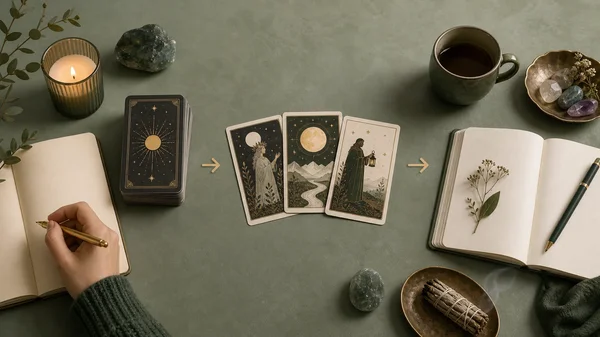
A tarot reading usually begins with attention. The reader or seeker chooses a question, sets an intention, selects a spread, draws cards, and interprets each card in context. In digital readings, the shuffle and draw happen through an online tool rather than a physical deck, but the interpretive process remains similar.
The question matters because tarot is symbolic. A vague question tends to produce a vague reflection. "What should I know about my week?" gives the cards a broader frame, while "What energy should I bring to this difficult conversation?" creates a more useful lens. A reading becomes clearer when the question leaves room for agency rather than asking the cards to make a decision for you.
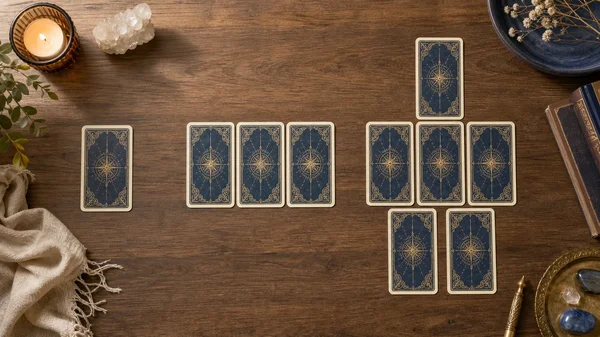
The spread also matters. A single card is best for a quick theme. A three-card spread can compare past, present, and future, or situation, challenge, and advice. A 7 card tarot reading free layout often appeals to people who want more detail, while a free tarot reading 10 card spread usually suits larger life questions. Random Tarot Card focuses on single-card and light spread options, which makes the process easier to keep grounded.
Finally, interpretation connects the card meaning to the question. The same card can feel different in a love question, a career reflection, or a daily pull. The point is not to force the card into a rigid answer. The point is to ask, "What does this symbol help me notice?"
What Free Tarot Reading Divination Can and Cannot Tell You
Searches such as "most accurate tarot reading free," "free tarot reading by date of birth," and "who will I marry tarot free reading" show a real desire for certainty. That desire is understandable. People often look for tarot when they feel between choices, emotionally invested, or unsure how to read a situation.
Still, a responsible reading should not promise certainty. Tarot can help you explore attraction, timing, communication patterns, hopes, fears, and next steps. It cannot verify another person's private feelings, tell you exactly who you will marry, or replace direct communication. Love readings are most useful when they bring your attention back to your values and behavior, not when they invite you to wait passively for a fixed outcome.
Date-of-birth readings have a similar limitation. Birth information can be used in some systems to add numerological or astrological context, but tarot itself works through card symbolism and spread position. If a reading mentions your birth date, treat it as an added interpretive layer rather than proof of accuracy.
A free tarot reading divination session is strongest when it gives you a clearer question, a calmer mind, or a next reflection to journal about. It is weakest when it tries to replace lived evidence with dramatic certainty.
Choosing a Spread: 3 Card, 7 Card, or 10 Card?
Different spreads answer different levels of complexity. More cards do not automatically mean a better reading. A larger spread simply creates more positions to interpret, which can be helpful or overwhelming depending on the question.
A free 3 card tarot reading is ideal when you want a balanced but simple answer. Common structures include past-present-future, mind-body-spirit, situation-obstacle-advice, or you-them-relationship. Three cards give enough contrast to see movement without burying the reader in details.
A 7 card tarot reading free love spread can be useful when a relationship question has several moving parts: your feelings, the other person's visible behavior, shared patterns, hidden tension, likely direction, advice, and what to release. Even then, the reading should stay ethical. It can reflect on the dynamic, but it should not claim access to someone's private inner world.
A free tarot reading 10 card spread, such as a Celtic Cross-style layout, fits a layered question. It may look at the present situation, challenge, foundation, recent past, conscious aim, near future, self-perception, environment, hopes or fears, and possible outcome. This level of detail is helpful when you are prepared to spend time with the answer.
For quick daily reflection, begin smaller. A single card or three cards often gives enough material for one useful insight.
A Practical Framework for Reading the Cards
Use this framework when you want a reading to feel clear rather than chaotic.
First, write the question in one sentence. Make it open-ended and centered on your role: "What should I consider before responding?" is more constructive than "Will they do what I want?"
Second, choose the smallest spread that fits the question. If you can answer the question with one card, use one card. If you need contrast, use three. If the issue has many layers and you have time to reflect, use seven or ten.
Third, read each card in three passes. Start with the basic meaning, then look at the image and emotional tone, then connect it to the spread position. This keeps the reading from becoming a list of disconnected card definitions.
Fourth, name one practical reflection. A good result might be, "I need to pause before reacting," "I am focusing too much on the outcome," or "I should ask a clearer question before deciding." That reflection is more useful than trying to extract a perfect prediction.
Fifth, avoid repeating the same reading immediately. If you ask the same question over and over, the answers can become noise. Wait until the situation changes, your question changes, or you have acted on the first reflection.
Tarot, Zodiac Questions, and the Aries Card
One People Also Ask question around this topic is, "What is the Tarot card for Aries?" In many tarot and astrology correspondences, Aries is commonly associated with The Emperor. The Emperor often represents structure, initiative, leadership, boundaries, and the ability to act with purpose.
That association can be useful, but it should not be treated as the only way to understand Aries energy. If The Emperor appears in a reading, it may ask you to notice where you need clearer structure, where you are pushing too hard, or where confident action would help. In a relationship question, it may point to boundaries or power dynamics. In a work question, it may point to leadership, planning, or accountability.
Astrological correspondences are optional layers. You do not need to know zodiac systems to benefit from tarot card reading divination. If an association helps you reflect, use it. If it distracts from the question, return to the card, the spread, and the situation in front of you.
Reading the Result Without Giving Away Your Agency
The unspoken rule of tarot cards is not really a secret rule. It is a practice boundary: respect the reading, but do not surrender your agency to it. A card can highlight a pattern. It should not become a command.
That boundary matters most in emotionally charged readings. If you are asking about love, avoid using tarot to monitor someone else's private thoughts. If you are asking about health, money, law, or safety, use tarot only as a reflection tool and seek appropriate professional support for decisions in those areas. If you are asking about a conflict, let the reading help you prepare your words rather than decide what another person must do.
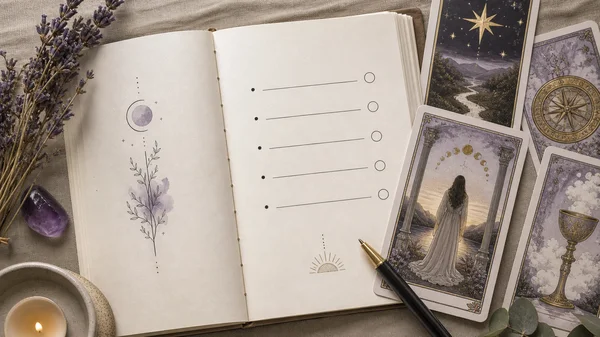
It also helps to record the reading. Write down the question, the card or spread, your first interpretation, and one grounded next step. When you review it later, you may notice whether the reading clarified your thinking or simply mirrored a mood you were already in.
The best tarot practice keeps curiosity and responsibility together. It lets mystery open a door, then asks you to walk through with your eyes open.
Using Tarot Reading Divination for Daily Reflection
Tarot reading divination becomes most useful when it is part of a steady reflection habit rather than a search for perfect certainty. A one-card pull in the morning can give you a theme. A three-card spread at night can help you review what happened, what challenged you, and what you learned. A larger spread can wait for moments when you truly need more structure.
If you use an online tool, keep the session simple. Choose a question, draw the card, read the meaning, and pause before reacting. A lightweight ritual can still be meaningful when it is honest about its limits. Random Tarot Card is built as a quiet space for tarot reflection, not a pressure-filled promise machine.
The real value is the conversation the reading starts inside your own attention. Let the cards suggest language, symbols, and possibilities. Then let your judgment, values, and real-world information shape what you do next.

FAQ
Is tarot card reading considered divination?
Yes. Tarot card reading is widely considered divination because it uses cards and symbolic interpretation to explore a question or situation. It can be practiced as fortune telling, spiritual guidance, self-reflection, or journaling, depending on the reader's approach.
How does tarot divination work?
Tarot divination works by combining a question, a card draw, a spread structure, and interpretation. The reader connects card meanings, imagery, positions, and context to form a reflective answer. In an online reading, the draw is digital, but the interpretation still depends on the question and the reader's attention.
Are free tarot readings accurate?
Free tarot readings can feel useful when the question is clear and the interpretation is thoughtful. They should not be treated as certain predictions. A better measure is whether the reading helps you reflect, ask better questions, and choose a grounded next step.
What is the Tarot card for Aries?
In many tarot-astrology systems, Aries is associated with The Emperor. This card often points to initiative, structure, boundaries, and leadership. The association is helpful as an interpretive layer, but it is not required for every tarot reading.
What is the unspoken rule of tarot cards?
The main unspoken rule is to keep your agency. Use tarot for insight, reflection, and perspective, but do not let a card replace consent, evidence, professional support, or your own judgment.
Which spread should I use for a first tarot reading divination session?
Use a single card if you want one theme, or a three-card spread if you want simple contrast. Larger 7-card and 10-card spreads are better when the question has several layers and you have enough time to reflect on the answer.